P-ml writes when the script runsDictionary of Applied Machine Learning · norm
Numerical companion to the entry norm: it recomputes what the entry states and prints one line per check
One block per paragraph of the entry (marked [P...]): each block verifies numerically what the corresponding statement asserts. Self-contained (numpy/matplotlib only), fixed seed.
Run it with python3 norm.py, from any directory — it writes its output files into the current directory. Requires NumPy and Matplotlib only, and uses fixed seeds, so the printed numbers reproduce exactly. Download norm.py
One cell per block of the script: the code, and what that code printed when it last ran here
"""
norm.py — numerical companion to the glossary entry 'norm'.

One block per paragraph of the entry (marked [P...]): each block verifies
numerically what the corresponding statement asserts. Self-contained
(numpy/matplotlib only), fixed seed.

Blocks
------
[P-axioms] The three norm axioms — definiteness, homogeneity, triangle
           inequality — hold for the l1-, l2-, and linf-norms on random
           vector pairs (10^4 trials each).
[P-metric] d(u, v) = ||u - v|| is a metric: symmetry, identity of
           indiscernibles, and the triangle inequality checked on random
           triples.
[P-inner]  The inner product induces the l2-norm: ||u|| = sqrt(<u, u>)
           for random vectors.
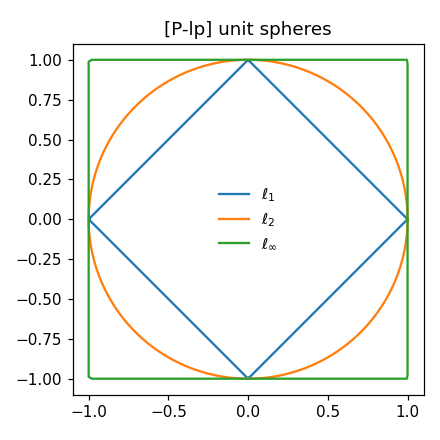
[P-lp]     The lp-norm family: the explicit sum formula matches
           np.linalg.norm for p in {1, 2, inf}, the linf-norm is the
           max absolute entry, and the unit spheres of l1/l2/linf are
           nested (||x||_inf <= ||x||_2 <= ||x||_1) — the geometry of
           the entry's unit-ball figure.
[P-ml]     Norms define losses and regularizers: the squared-error loss
           is a squared l2-norm of the residual, and the l1/l2
           regularizers evaluate norms of
           the parameter vector.

Outputs
-------
norm.png : preview figure (checking only).

Data generated by pythondemos/norm.py.
"""

import numpy as np
import matplotlib

matplotlib.use("Agg")
import matplotlib.pyplot as plt

rng = np.random.default_rng(42)
report = []


def check(name, ok):
    report.append((name, bool(ok)))
    print(f"  [{'ok' if ok else 'FAIL'}] {name}")


NORMS = {"l1": 1, "l2": 2, "linf": np.inf}
U = rng.normal(size=(10**4, 5))
V = rng.normal(size=(10**4, 5))
The three norm axioms — definiteness, homogeneity, triangle inequality — hold for the l1-, l2-, and linf-norms on random vector pairs (10^4 trials each).
print("[P-axioms] definiteness, homogeneity, triangle inequality")
for name, p in NORMS.items():
    nu = np.linalg.norm(U, p, axis=1)
    check(f"{name}: norm(0) = 0 and norm(u) > 0 for u != 0",
          np.linalg.norm(np.zeros(5), p) == 0 and np.all(nu > 0))
    a = rng.normal()
    check(f"{name}: homogeneity ||a u|| = |a| ||u||",
          np.allclose(np.linalg.norm(a * U, p, axis=1), abs(a) * nu))
    check(f"{name}: triangle ||u + v|| <= ||u|| + ||v||",
          np.all(np.linalg.norm(U + V, p, axis=1)
                 <= nu + np.linalg.norm(V, p, axis=1) + 1e-12))
[P-axioms] definiteness, homogeneity, triangle inequality
  [ok] l1: norm(0) = 0 and norm(u) > 0 for u != 0
  [ok] l1: homogeneity ||a u|| = |a| ||u||
  [ok] l1: triangle ||u + v|| <= ||u|| + ||v||
  [ok] l2: norm(0) = 0 and norm(u) > 0 for u != 0
  [ok] l2: homogeneity ||a u|| = |a| ||u||
  [ok] l2: triangle ||u + v|| <= ||u|| + ||v||
  [ok] linf: norm(0) = 0 and norm(u) > 0 for u != 0
  [ok] linf: homogeneity ||a u|| = |a| ||u||
  [ok] linf: triangle ||u + v|| <= ||u|| + ||v||
d(u, v) = ||u - v|| is a metric: symmetry, identity of indiscernibles, and the triangle inequality checked on random triples.
print("[P-metric] d(u, v) = ||u - v|| is a metric")
W = rng.normal(size=(10**4, 5))
d = lambda X, Y: np.linalg.norm(X - Y, 2, axis=1)
check("symmetry d(u, v) = d(v, u)", np.allclose(d(U, V), d(V, U)))
check("d(u, u) = 0", np.all(d(U, U) == 0))
check("d(u, v) > 0 whenever u != v (identity of indiscernibles)",
      np.all(d(U, V)[np.any(U != V, axis=1)] > 0))
check("triangle d(u, w) <= d(u, v) + d(v, w)",
      np.all(d(U, W) <= d(U, V) + d(V, W) + 1e-12))
[P-metric] d(u, v) = ||u - v|| is a metric
  [ok] symmetry d(u, v) = d(v, u)
  [ok] d(u, u) = 0
  [ok] d(u, v) > 0 whenever u != v (identity of indiscernibles)
  [ok] triangle d(u, w) <= d(u, v) + d(v, w)
The inner product induces the l2-norm: ||u|| = sqrt(<u, u>) for random vectors.
print("[P-inner] the inner product induces the l2-norm")
check("||u|| = sqrt(<u, u>)",
      np.allclose(np.linalg.norm(U, 2, axis=1),
                  np.sqrt(np.sum(U * U, axis=1))))
[P-inner] the inner product induces the l2-norm
  [ok] ||u|| = sqrt(<u, u>)
The lp-norm family: the explicit sum formula matches np.linalg.norm for p in {1, 2, inf}, the linf-norm is the max absolute entry, and the unit spheres of l1/l2/linf are nested (||x||_inf <= ||x||_2 <= ||x||_1) — the geometry of the entry's unit-ball figure.
print("[P-lp] the lp family and its unit-ball geometry")
x = rng.normal(size=(10**4, 5))
lp_sum = lambda X, p: (np.sum(np.abs(X) ** p, axis=1)) ** (1 / p)
check("sum formula matches np.linalg.norm for p = 1, 2",
      np.allclose(lp_sum(x, 1), np.linalg.norm(x, 1, axis=1))
      and np.allclose(lp_sum(x, 2), np.linalg.norm(x, 2, axis=1)))
check("linf-norm is the max absolute entry",
      np.allclose(np.linalg.norm(x, np.inf, axis=1),
                  np.max(np.abs(x), axis=1)))
check("||x||_inf <= ||x||_2 <= ||x||_1 (nested unit balls)",
      np.all(np.linalg.norm(x, np.inf, axis=1)
             <= np.linalg.norm(x, 2, axis=1) + 1e-12)
      and np.all(np.linalg.norm(x, 2, axis=1)
                 <= np.linalg.norm(x, 1, axis=1) + 1e-12))
[P-lp] the lp family and its unit-ball geometry
  [ok] sum formula matches np.linalg.norm for p = 1, 2
  [ok] linf-norm is the max absolute entry
  [ok] ||x||_inf <= ||x||_2 <= ||x||_1 (nested unit balls)
Norms define losses and regularizers: the squared-error loss is a squared l2-norm of the residual, and the l1/l2 regularizers evaluate norms of the parameter vector.
print("[P-ml] norms define losses and regularizers")
Xf = rng.normal(size=(50, 3))
yf = Xf @ np.array([1.0, 0.0, -0.5]) + 0.1 * rng.normal(size=50)
w = np.linalg.lstsq(Xf, yf, rcond=None)[0]
sq_loss = np.mean((yf - Xf @ w) ** 2)
check("squared-error loss = (1/m) ||y - X w||_2^2",
      np.isclose(sq_loss, np.linalg.norm(yf - Xf @ w) ** 2 / 50))
check("ridge regularizer alpha ||w||_2^2 and Lasso regularizer "
      "alpha ||w||_1 are norm evaluations",
      np.isclose(np.linalg.norm(w, 2) ** 2, np.sum(w**2))
      and np.isclose(np.linalg.norm(w, 1), np.sum(np.abs(w))))

# ------------------------------------------------------------ preview
th = np.linspace(0, 2 * np.pi, 400)
circ = np.stack([np.cos(th), np.sin(th)])
fig, ax = plt.subplots(figsize=(4.0, 4.0))
ax.plot(*(circ / np.linalg.norm(circ, 1, axis=0)), label="$\\ell_1$")
ax.plot(*circ, label="$\\ell_2$")
ax.plot(*(circ / np.linalg.norm(circ, np.inf, axis=0)),
        label="$\\ell_\\infty$")
ax.set_aspect("equal"); ax.legend(frameon=False)
ax.set_title("[P-lp] unit spheres")
fig.tight_layout()
fig.savefig("norm.png", dpi=110)
print(f"\n{sum(ok for _, ok in report)}/{len(report)} checks passed")
assert all(ok for _, ok in report)
[P-ml] norms define losses and regularizers
  [ok] squared-error loss = (1/m) ||y - X w||_2^2
  [ok] ridge regularizer alpha ||w||_2^2 and Lasso regularizer alpha ||w||_1 are norm evaluations

19/19 checks passed
P-ml writes when the script runs