P-erm writes when the script runsDictionary of Applied Machine Learning · mean
Numerical companion to the entry mean: it recomputes what the entry states and prints one line per check
One block per paragraph of the entry (marked [P...]): each block verifies numerically what the corresponding statement asserts. Self-contained (numpy/matplotlib only), fixed seed.
Run it with python3 mean.py, from any directory — it writes its output files into the current directory. Requires NumPy and Matplotlib only, and uses fixed seeds, so the printed numbers reproduce exactly. Download mean.py
One cell per block of the script: the code, and what that code printed when it last ran here
"""
mean.py — numerical companion to the glossary entry 'mean'.

One block per paragraph of the entry (marked [P...]): each block verifies
numerically what the corresponding statement asserts. Self-contained
(numpy/matplotlib only), fixed seed.

Blocks
------
[P-def]     The mean of a random vector is its expectation, the Lebesgue
            integral of x with respect to its probability distribution:
            the Monte Carlo average of iid draws converges to the exact
            (analytic) mean as the sample grows.
[P-sample]  A dataset D defines a discrete RV x~ = x^(I) with I uniform on
            {1,...,m}; the mean of x~ equals the sample mean
            (1/m) sum_r x^(r) exactly.
[P-argmin]  For an RV with finite second moment, E{x} minimizes the risk
            E{||x - c||^2}: the analytic mean beats every candidate c on a
            grid, and the empirical risk curve has its minimum at the
            sample mean.
[P-erm]     Featureless regression: ERM with squared error loss over
            labels y^(1..m) is solved by the sample mean — the closed-form
            minimizer of (1/m) sum_r (y^(r) - h)^2 equals np.mean(y), and
            every other h has larger empirical risk (setting of Fig. 1,
            m = 5 labels with mean 4).

Outputs
-------
mean.png : preview figure (checking only).

Data generated by pythondemos/mean.py.
"""

import numpy as np
import matplotlib

matplotlib.use("Agg")
import matplotlib.pyplot as plt

rng = np.random.default_rng(42)
report = []


def check(name, ok):
    report.append((name, bool(ok)))
    print(f"  [{'ok' if ok else 'FAIL'}] {name}")
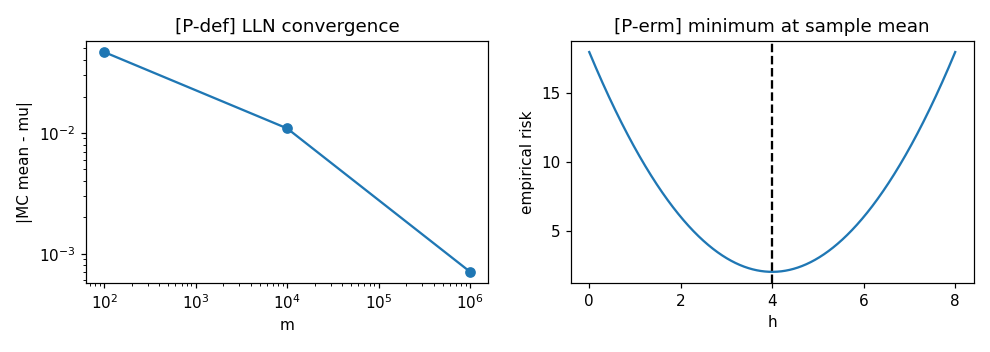
The mean of a random vector is its expectation, the Lebesgue integral of x with respect to its probability distribution: the Monte Carlo average of iid draws converges to the exact (analytic) mean as the sample grows.
# Mean = expectation = integral of x dP(x). Monte Carlo average of iid
# draws from N(mu, C) converges to the analytic mean mu.
print("[P-def] Monte Carlo average converges to the analytic mean")
mu = np.array([1.0, -2.0])
A = np.array([[1.0, 0.0], [0.5, 0.8]])
errs = []
for m in [10**2, 10**4, 10**6]:
    x = rng.standard_normal((m, 2)) @ A.T + mu
    errs.append(np.linalg.norm(x.mean(axis=0) - mu))
print(f"    |MC mean - mu| for m=1e2,1e4,1e6: "
      f"{errs[0]:.4f}, {errs[1]:.4f}, {errs[2]:.4f}")
check("MC error shrinks monotonically", errs[0] > errs[1] > errs[2])
check("MC mean at m=1e6 within 3e-3 of mu", errs[2] < 3e-3)
[P-def] Monte Carlo average converges to the analytic mean
    |MC mean - mu| for m=1e2,1e4,1e6: 0.0467, 0.0109, 0.0007
  [ok] MC error shrinks monotonically
  [ok] MC mean at m=1e6 within 3e-3 of mu
A dataset D defines a discrete RV x~ = x^(I) with I uniform on {1,...,m}; the mean of x~ equals the sample mean (1/m) sum_r x^(r) exactly.
# Discrete RV x~ = x^(I), I uniform on {1,...,m}: its mean is exactly the
# sample mean of the dataset.
print("[P-sample] dataset-induced discrete RV has mean = sample mean")
D = rng.normal(size=(7, 2))
probs = np.full(7, 1 / 7)                      # P(I = r) = 1/m
mean_discrete = (probs[:, None] * D).sum(axis=0)
check("E{x^(I)} equals (1/m) sum_r x^(r)",
      np.allclose(mean_discrete, D.mean(axis=0)))
[P-sample] dataset-induced discrete RV has mean = sample mean
  [ok] E{x^(I)} equals (1/m) sum_r x^(r)
For an RV with finite second moment, E{x} minimizes the risk E{||x - c||^2}: the analytic mean beats every candidate c on a grid, and the empirical risk curve has its minimum at the sample mean.
# E{x} = argmin_c E{||x - c||^2}. Empirically: risk(c) >= risk(mean) for
# every c on a grid, with equality only at c = mean.
print("[P-argmin] the mean minimizes the expected squared distance")
x = rng.standard_normal((200000, 2)) @ A.T + mu
def emp_risk(c):
    return np.mean(np.sum((x - c) ** 2, axis=1))
risk_mean = emp_risk(x.mean(axis=0))
grid = [x.mean(axis=0) + d for d in
        (np.array([0.5, 0]), np.array([-0.3, 0.4]), np.array([0, -1.0]))]
check("risk(mean) < risk(c) for all offset candidates c",
      all(emp_risk(c) > risk_mean for c in grid))
[P-argmin] the mean minimizes the expected squared distance
  [ok] risk(mean) < risk(c) for all offset candidates c
Featureless regression: ERM with squared error loss over labels y^(1..m) is solved by the sample mean — the closed-form minimizer of (1/m) sum_r (y^(r) - h)^2 equals np.mean(y), and every other h has larger empirical risk (setting of Fig. 1, m = 5 labels with mean 4).
# Featureless regression (Fig. 1 setting): labels 2,5,3,6,4; ERM with the
# squared error loss is solved by the sample mean h_hat = 4.
print("[P-erm] featureless ERM with squared loss = sample mean")
y = np.array([2.0, 5.0, 3.0, 6.0, 4.0])
h_grid = np.linspace(0, 8, 1601)
emp = np.array([np.mean((y - h) ** 2) for h in h_grid])
h_hat = h_grid[np.argmin(emp)]
check("grid minimizer equals np.mean(y) = 4", abs(h_hat - y.mean()) < 5e-3)
check("sample mean is 4 (entry Fig. 1)", np.isclose(y.mean(), 4.0))
check("every other h has larger empirical risk",
      np.all(emp >= np.mean((y - y.mean()) ** 2) - 1e-12))

# ------------------------------------------------------------ preview
fig, ax = plt.subplots(1, 2, figsize=(9, 3.2))
ax[0].loglog([1e2, 1e4, 1e6], errs, "o-")
ax[0].set_xlabel("m"); ax[0].set_ylabel("|MC mean - mu|")
ax[0].set_title("[P-def] average approaches the mean")
ax[1].plot(h_grid, emp)
ax[1].axvline(y.mean(), ls="--", c="k")
ax[1].set_xlabel("h"); ax[1].set_ylabel("empirical risk")
ax[1].set_title("[P-erm] minimum at sample mean")
fig.tight_layout()
fig.savefig("mean.png", dpi=110)
print(f"\n{sum(ok for _, ok in report)}/{len(report)} checks passed")
assert all(ok for _, ok in report)
[P-erm] featureless ERM with squared loss = sample mean
  [ok] grid minimizer equals np.mean(y) = 4
  [ok] sample mean is 4 (entry Fig. 1)
  [ok] every other h has larger empirical risk

7/7 checks passed
P-erm writes when the script runs