P-diag writes when the script runsDictionary of Applied Machine Learning · eigenvalue decomposition
Numerical companion to the entry eigenvalue decomposition: it recomputes what the entry states and prints one line per check
One block per paragraph of the entry (marked [P...]): each block verifies numerically what the corresponding statement asserts. Self-contained (numpy/matplotlib only), fixed seed.
Run it with python3 evd.py, from any directory — it writes its output files into the current directory. Requires NumPy and Matplotlib only, and uses fixed seeds, so the printed numbers reproduce exactly. Download evd.py
One cell per block of the script: the code, and what that code printed when it last ran here
"""
evd.py — numerical companion to the glossary entry
'eigenvalue decomposition (EVD)'.

One block per paragraph of the entry (marked [P...]): each block verifies
numerically what the corresponding statement asserts. Self-contained
(numpy/matplotlib only), fixed seed.

Blocks
------
[P-def]  The EVD A = V Lambda V^{-1}: reconstructing A from the factors
         returned by np.linalg.eig gives A back to machine precision; the
         columns of V are eigenvectors and Lambda is diagonal with the
         matching eigenvalues.
[P-diag] Matrices that admit an EVD are the diagonalizable ones: for the
         defective matrix [[0, 1], [0, 0]] the eigenvector matrix is
         singular (rank 1), so V^{-1} does not exist and no EVD is
         possible, while the diagonalizable matrix A above passes.

Outputs
-------
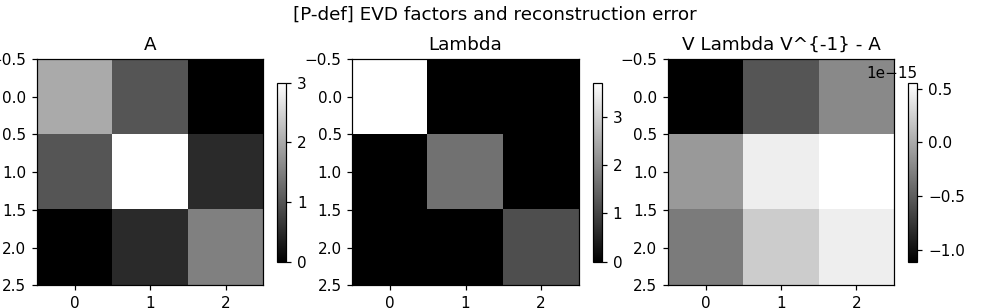
evd.png : preview figure (checking only).

Data generated by pythondemos/evd.py.
"""

import numpy as np
import matplotlib

matplotlib.use("Agg")
import matplotlib.pyplot as plt

rng = np.random.default_rng(42)
report = []


def check(name, ok):
    report.append((name, bool(ok)))
    print(f"  [{'ok' if ok else 'FAIL'}] {name}")
The EVD A = V Lambda V^{-1}: reconstructing A from the factors returned by np.linalg.eig gives A back to machine precision; the columns of V are eigenvectors and Lambda is diagonal with the matching eigenvalues.
print("[P-def] A = V Lambda V^{-1} reconstructs A")
A = np.array([[2.0, 1.0, 0.0], [1.0, 3.0, 0.5], [0.0, 0.5, 1.5]])
lam, V = np.linalg.eig(A)
Lam = np.diag(lam)
A_rec = V @ Lam @ np.linalg.inv(V)
check("reconstruction error < 1e-12",
      np.max(np.abs(A_rec - A)) < 1e-12)
check("columns of V are eigenvectors (A v = lambda v)",
      all(np.linalg.norm(A @ V[:, i] - lam[i] * V[:, i]) < 1e-12
          for i in range(3)))
check("Lambda is diagonal", np.allclose(Lam, np.diag(np.diag(Lam))))
[P-def] A = V Lambda V^{-1} reconstructs A
  [ok] reconstruction error < 1e-12
  [ok] columns of V are eigenvectors (A v = lambda v)
  [ok] Lambda is diagonal
Matrices that admit an EVD are the diagonalizable ones: for the defective matrix [[0, 1], [0, 0]] the eigenvector matrix is singular (rank 1), so V^{-1} does not exist and no EVD is possible, while the diagonalizable matrix A above passes.
print("[P-diag] EVD exists iff the matrix is diagonalizable")
D = np.array([[0.0, 1.0], [0.0, 0.0]])         # defective (not diagonalizable)
lamD, VD = np.linalg.eig(D)
rank_VD = np.linalg.matrix_rank(VD)
check("defective matrix: eigenvector matrix is singular (rank 1)",
      rank_VD == 1)
sym = A                                         # symmetric example above
check("diagonalizable matrix: eigenvector matrix invertible (rank 3)",
      np.linalg.matrix_rank(V) == 3)

# ------------------------------------------------------------ preview
fig, ax = plt.subplots(1, 3, figsize=(9, 2.8))
for a, M, t in ((ax[0], A, "A"), (ax[1], Lam.real, "Lambda"),
                (ax[2], (A_rec - A).real, "V Lambda V^{-1} - A")):
    im = a.imshow(M, cmap="gray"); a.set_title(t)
    fig.colorbar(im, ax=a, shrink=0.75)
fig.suptitle("[P-def] EVD factors and reconstruction error")
fig.tight_layout()
fig.savefig("evd.png", dpi=110)
print(f"\n{sum(ok for _, ok in report)}/{len(report)} checks passed")
assert all(ok for _, ok in report)
[P-diag] EVD exists iff the matrix is diagonalizable
  [ok] defective matrix: eigenvector matrix is singular (rank 1)
  [ok] diagonalizable matrix: eigenvector matrix invertible (rank 3)

5/5 checks passed
P-diag writes when the script runs