P-dataset writes when the script runsDictionary of Applied Machine Learning · data
Numerical companion to the entry data: it recomputes what the entry states and prints one line per check
One block per paragraph of the entry (marked [P...]): each block verifies numerically what the corresponding statement asserts. Self-contained (numpy/matplotlib only), fixed seed.
Run it with python3 data.py, from any directory — it writes its output files into the current directory. Requires NumPy and Matplotlib only, and uses fixed seeds, so the printed numbers reproduce exactly. Download data.py
One cell per block of the script: the code, and what that code printed when it last ran here
"""
data.py — numerical companion to the glossary entry 'data'.

One block per paragraph of the entry (marked [P...]): each block verifies
numerically what the corresponding statement asserts. Self-contained
(numpy/matplotlib only), fixed seed.

Blocks
------
[P-record]    Data are representations of information recorded in a form
              suitable for storage, communication, and processing: a
              temperature reading with timestamp survives a round trip
              through serialized bytes unchanged. The usefulness of a
              learned hypothesis is limited by data quality and
              quantity: test error decreases with the trainset size and
              increases with measurement noise.
[P-datapoint] The unit sense: a data point (x, y) bundles features and
              a label; the entry's convention x easy to obtain, y the
              quantity of interest.
[P-dataset]   The collection sense: a dataset of m data points supports
              model training and validation via a train/validation
              split.

Outputs
-------
data.png : preview figure (checking only).

Data generated by pythondemos/data.py.
"""

import numpy as np
import matplotlib

matplotlib.use("Agg")
import matplotlib.pyplot as plt

rng = np.random.default_rng(42)
report = []


def check(name, ok):
    report.append((name, bool(ok)))
    print(f"  [{'ok' if ok else 'FAIL'}] {name}")
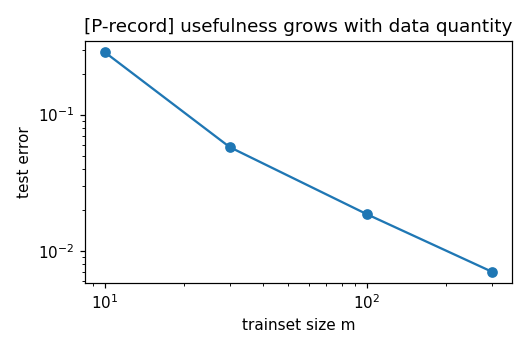
Data are representations of information recorded in a form suitable for storage, communication, and processing: a temperature reading with timestamp survives a round trip through serialized bytes unchanged. The usefulness of a learned hypothesis is limited by data quality and quantity: test error decreases with the trainset size and increases with measurement noise.
print("[P-record] recorded, storable, communicable representations")
reading = np.array([(1717.25, 23.4)],
                   dtype=[("t", "f8"), ("temp", "f8")])
blob = reading.tobytes()                          # storage/communication
restored = np.frombuffer(blob, dtype=reading.dtype)
check("a temperature reading survives the storage round trip",
      restored["temp"][0] == 23.4 and restored["t"][0] == 1717.25)
# quality and quantity limit the learned hypothesis
def test_err(m, noise):
    x = rng.uniform(0, 10, m)
    y = 2.0 * x + 1.0 + noise * rng.normal(size=m)
    c = np.polyfit(x, y, 1)
    xt = rng.uniform(0, 10, 2000)
    return np.mean((2.0 * xt + 1.0 - np.polyval(c, xt)) ** 2)
e_small, e_large = np.mean([test_err(10, 1.0) for _ in range(40)]), \
                   np.mean([test_err(200, 1.0) for _ in range(40)])
e_clean, e_noisy = np.mean([test_err(50, 0.2) for _ in range(40)]), \
                   np.mean([test_err(50, 2.0) for _ in range(40)])
check("more data points -> lower test error (quantity)",
      e_large < e_small)
check("noisier recordings -> higher test error (quality)",
      e_noisy > e_clean)
[P-record] recorded, storable, communicable representations
  [ok] a temperature reading survives the storage round trip
  [ok] more data points -> lower test error (quantity)
  [ok] noisier recordings -> higher test error (quality)
The unit sense: a data point (x, y) bundles features and a label; the entry's convention x easy to obtain, y the quantity of interest.
print("[P-datapoint] the unit sense: features and label")
z = {"x": np.array([23.4, 55.0]), "y": 1.0}       # (features, label)
check("a data point bundles features and a label",
      z["x"].shape == (2,) and np.isscalar(z["y"]))
[P-datapoint] the unit sense: features and label
  [ok] a data point bundles features and a label
The collection sense: a dataset of m data points supports model training and validation via a train/validation split.
print("[P-dataset] the collection sense: training and validation")
m = 100
X = rng.uniform(0, 10, m)
Y = 2.0 * X + 1.0 + 0.5 * rng.normal(size=m)
tr, va = slice(0, 80), slice(80, 100)
c = np.polyfit(X[tr], Y[tr], 1)
val_err = np.mean((Y[va] - np.polyval(c, X[va])) ** 2)
check("the dataset supports training (fit on the training part)",
      np.all(np.isfinite(c)))
check("and validation (error evaluated on held-out data points)",
      np.isfinite(val_err) and val_err < 1.0)

# ------------------------------------------------------------ preview
fig, ax = plt.subplots(figsize=(4.8, 3.2))
ms = [10, 30, 100, 300]
ax.loglog(ms, [np.mean([test_err(mm, 1.0) for _ in range(30)])
               for mm in ms], "o-")
ax.set_xlabel("trainset size m"); ax.set_ylabel("test error")
ax.set_title("[P-record] usefulness grows with data quantity")
fig.tight_layout()
fig.savefig("data.png", dpi=110)
print(f"\n{sum(ok for _, ok in report)}/{len(report)} checks passed")
assert all(ok for _, ok in report)
[P-dataset] the collection sense: training and validation
  [ok] the dataset supports training (fit on the training part)
  [ok] and validation (error evaluated on held-out data points)

6/6 checks passed
P-dataset writes when the script runs